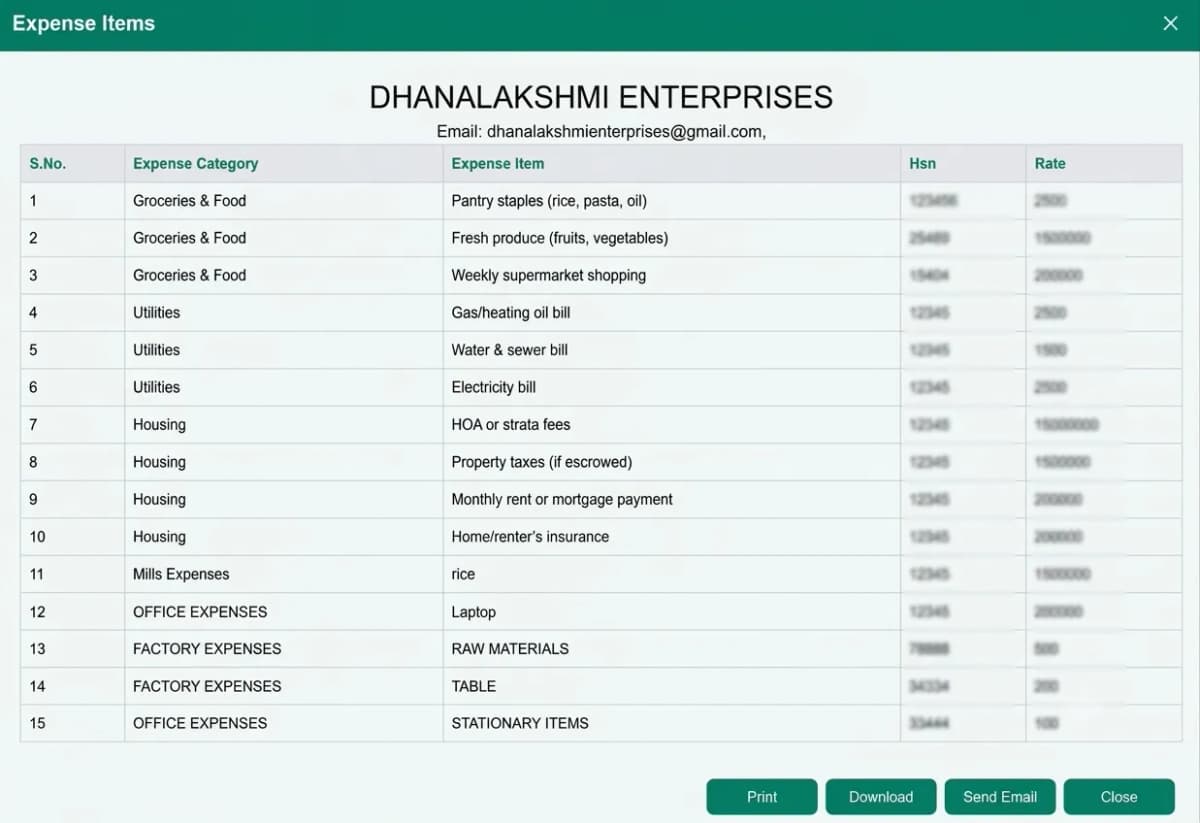
Expense Items
Report – Track Item-Wise Costs
Gain granular visibility into your business spending with comprehensive expense items reports. Track individual expense items, analyze purchasing patterns, and make informed decisions for better procurement management, cost control, and business profitability.
Item-Level Tracking
Granular visibility
Cost Analysis
Item-wise insights
Procurement Control
Smart purchasing
Financial Oversight
Complete control
Everything You Need to Track Expenses by Item
Create Invoices
Generate professional GST invoices and purchase invoices instantly.
Track Expense Items
Monitor individual expense items including materials and supplies.
Manage Payments
Track vendor payments and purchase invoice settlements.
Item Reports
Generate detailed expense items reports with analytics.
Cost Analytics
Analyze item-wise spending patterns and optimize costs.
Expense Items
Report
Gain granular visibility into your business spending with comprehensive item-level expense tracking and reporting.
Key Insight: Item-level expense tracking enables businesses to identify cost drivers, optimize procurement, and improve profitability through data-driven purchasing decisions.
Faster Item Tracking
Better Accuracy
Item Visibility
Cost Optimization
Item-Level Expense Tracking
GranularCapture and track individual expense items from purchase invoices including materials, supplies, and services.
Item-Wise Cost Analytics
InsightfulAnalyze spending patterns for each expense item with interactive dashboards and trend analysis.
Procurement Management
StrategicOptimize purchasing decisions with detailed item-level data on costs, quantities, and supplier performance.
Budget vs. Actual by Item
Real-timeTrack budget adherence for each expense item and identify variances for immediate action.
Why Item-Level Tracking Matters
- ▸Complete visibility into spending on individual items
- ▸Identify high-cost products and services instantly
- ▸Automated item capture from purchase invoices
- ▸Improved procurement and inventory management
- ▸Data-driven supplier negotiation and sourcing
Key Business Benefits
- ▸75% faster expense item tracking and reporting
- ▸90% improvement in item classification accuracy
- ▸Enhanced procurement and cost control capabilities
- ▸Strengthened financial governance and compliance
- ▸Greater transparency in purchasing decisions
Optimize Your Expense Item Tracking
Implement these strategies to maximize efficiency and accuracy
Standardize Items
Create consistent item descriptions and codes
Automate Capture
Auto-extract items from purchase invoices
Analyze Trends
Review item spending patterns monthly
Optimize Costs
Identify cost-saving opportunities
How Item Reports Drive Better Procurement Decisions
Item-level expense reports provide granular insights to identify high-cost items, optimize procurement strategies, and negotiate better supplier terms. Real-time visibility into each expense item enables quick adaptation and improved profitability.
Complete Guide to Expense Item Tracking
Expense items reports are essential for understanding and managing business spending at the granular level. By automatically capturing item-level data from purchase invoices and vendor bills, organizations gain complete visibility into their procurement activities.
What is an Expense Items Report?
An Expense Items Report is a detailed financial document that tracks and analyzes business expenses at the individual item level. This comprehensive report lists every expense item purchased by the business, including materials, office supplies, inventory purchases, equipment, services, and operational costs. By providing line-item visibility into spending, this report enables businesses to identify high-cost items, track procurement patterns, and make informed purchasing decisions. Modern expense items reports integrate seamlessly with billing software and invoice management systems, automatically extracting item-level data from purchase invoices and vendor bills to create accurate, real-time expenditure summaries.
How Purchase Invoices Drive Item-Wise Expense Tracking
Purchase invoices are the primary source of item-level expense data. Every purchase invoice from vendors contains detailed line items including product descriptions, quantities, unit prices, total amounts, and GST tax details. Expense items report software automatically extracts this data, categorizes each item appropriately, and generates comprehensive item-wise expense reports. This automation ensures that every expense item is properly tracked, providing businesses with granular visibility into what they're buying, from whom, and at what cost. This detailed tracking is essential for accurate business accounting, cost control, and financial reporting.
Benefits of Tracking Expenses at the Item Level
Item-level expense tracking offers numerous advantages for businesses of all sizes. By monitoring individual expense items, organizations can identify which products or services are driving costs, negotiate better pricing with suppliers, and eliminate unnecessary purchases. This granular approach to expense management enables better budget control, improved procurement planning, and more accurate financial forecasting. For businesses using billing software and expense management tools, automated item-level tracking eliminates manual data entry, reduces errors, and delivers real-time insights into spending patterns. This detailed visibility empowers businesses to optimize costs and improve profitability.
Common Expense Items in Business Operations
Businesses track a wide variety of expense items across their operations. Common expense items include: Raw Materials and Inventory Purchases, Office Supplies (stationery, printer ink, paper), Equipment and Machinery, IT Hardware and Software, Professional Services (legal, accounting, consulting), Marketing and Advertising Services, Travel and Transportation Services, Utilities and Maintenance Services, Staff Training and Development, and Rent and Lease Items. Each of these items represents a specific cost that contributes to overall business expenses. Effective expense items reports provide detailed breakdowns of spending across all these item categories, enabling businesses to analyze costs at a granular level.
How Expense Items Reports Improve Procurement and Cost Control
Expense items reports are essential tools for effective procurement management and cost control. By providing detailed insights into spending on individual items, these reports help businesses identify which products or services are consuming the most resources and where savings can be achieved. Procurement teams can analyze item-level spending to negotiate better terms with suppliers, consolidate orders, and implement strategic sourcing initiatives. Finance teams can compare actual spending against budgets for specific items, quickly identifying variances and taking corrective action. Regular review of expense items reports also helps businesses adapt to changing market conditions and optimize their procurement strategies.
Streamlining Expense Item Tracking with Automated Software
Modern expense management software and accounting platforms have revolutionized how businesses track expense items. Automated systems can intelligently capture item-level data from purchase invoices, extract product descriptions, quantities, unit prices, and total amounts, and generate detailed expense items reports in real-time. By integrating with billing software and invoice generators, these tools ensure that every expense item is accurately recorded and categorized. This automation eliminates manual data entry, reduces classification errors, and provides businesses with instant access to item-wise expense data. The result is more accurate financial reporting, better cost control, and improved business decision-making.
Start Optimizing Your Expense Item Tracking
Effective item-level expense tracking helps businesses maintain financial control, optimize procurement, and achieve sustainable growth through informed purchasing decisions.
Pro Tip
Combine expense items reports with billing software for complete financial ecosystem.