Expense Category
Report – Classify & Analyze Costs
Gain complete visibility into your business spending with comprehensive expense category reports. Classify expenses by category, track spending patterns, and make informed financial decisions for better budgeting, cost control, and business growth.
Automated Categorization
Smart classification
Cost Analysis
Category insights
Budget Tracking
Real-time monitoring
Financial Control
Complete oversight
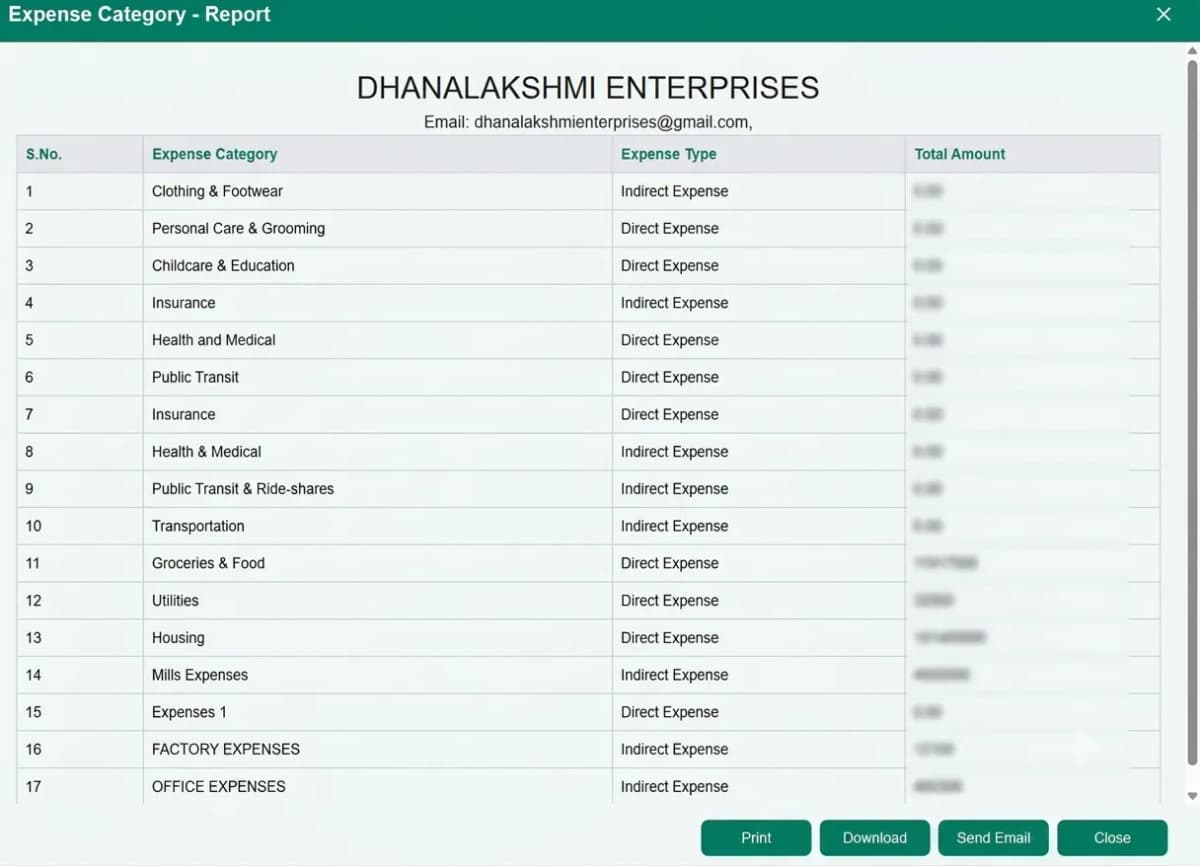
Everything You Need to Manage Expenses by Category
Create Invoices
Generate professional GST invoices and purchase invoices instantly.
Categorize Expenses
Classify expenses by category for better financial visibility.
Track Payments
Monitor vendor bills, payments, and outstanding expenses.
Category Reports
Generate detailed expense category reports and analytics.
Cost Analysis
Analyze spending patterns by category and optimize budgets.
Understand Your Spending with Category Reports
Automatically classify expenses, track spending patterns, and make data-driven decisions with comprehensive expense category reports.
Automated Category Classification
SmartIntelligently classify expenses from purchase invoices using AI-powered categorization.
Real-Time Category Analytics
LiveMonitor spending patterns across all expense categories with interactive dashboards.
Vendor & Category Mapping
AutomatedAutomatically map vendors to appropriate categories for consistent reporting.
Budget vs. Actual Comparison
InsightfulTrack category budgets against actual spending and identify variances instantly.
Why Category Reports Matter
- Complete visibility into spending by category
- Identify cost-saving opportunities instantly
- Automated classification from purchase invoices
- Improved financial reporting accuracy
- Data-driven resource allocation
Key Business Benefits
- 70% faster expense reporting and categorization
- 85% improvement in classification accuracy
- Enhanced budget management capabilities
- Strengthened financial governance
- Greater financial transparency
Best Practices
Maximize your expense categorization efficiency
Standardize
Create consistent category structure
Automate
Use AI for classification
Analyze
Review trends monthly
Monitor
Track budgets in real-time
How Category Reports Drive Better Decisions
Category-level expense reports provide granular insights to identify spending trends, optimize budgets, and make strategic decisions. Real-time visibility into each category enables quick adaptation and improved profitability.
Complete Guide to Expense Categorization
Expense category reports are essential for understanding and managing business spending. By automatically classifying expenses from purchase invoices and vendor bills, organizations gain complete visibility and can make data-driven decisions.
What is an Expense Category Report?
An Expense Category Report is a comprehensive financial document that classifies and summarizes business expenses by predefined categories such as rent, utilities, travel, inventory purchases, salaries, marketing, and operational costs. This report provides businesses with a clear breakdown of where money is being spent, enabling better financial oversight and strategic planning. By organizing expenses into meaningful categories, organizations can identify spending patterns, track budget adherence, and make informed decisions about resource allocation. Modern expense category reports integrate seamlessly with billing software and invoice management systems, automatically pulling data from purchase invoices and vendor bills to create accurate, real-time expense summaries.
How Invoices Drive Expense Categorization and Reporting
Invoices are the primary source of expense data for accurate category reporting. Every purchase invoice and vendor bill contains critical information that determines how an expense should be classified. When you receive a supplier invoice for office supplies, it's categorized under 'Office Expenses'; a utility bill falls under 'Utilities'; and a vendor invoice for inventory goes to 'Cost of Goods Sold'. Expense category report software automatically extracts this data from invoices, applies appropriate category labels based on predefined rules, and generates comprehensive reports. This automation ensures that every expense is properly classified, providing businesses with accurate, actionable insights into their spending patterns.
Benefits of Tracking Expenses by Category
Categorizing expenses offers numerous benefits for businesses of all sizes. By tracking expenses by category, organizations can identify areas of overspending, uncover cost-saving opportunities, and ensure that budgets align with business priorities. Category-level expense tracking enables better financial forecasting, improves tax preparation by organizing deductible expenses, and provides clear visibility into operational costs. For businesses using billing software and expense management tools, automated category tracking eliminates manual errors, saves time, and delivers real-time insights into financial performance. This structured approach to expense management empowers business owners and finance teams to make data-driven decisions that drive profitability and growth.
Common Expense Categories for Business Reporting
Businesses typically track expenses across several key categories to maintain comprehensive financial oversight. Common expense categories include: Office Rent and Lease Payments, Utilities (electricity, water, internet), Employee Salaries and Wages, Marketing and Advertising Costs, Travel and Entertainment Expenses, Inventory Purchases and Cost of Goods Sold, Professional Services (legal, accounting, consulting), Office Supplies and Equipment, Insurance Premiums, and Technology and Software Subscriptions. Each of these categories may be further subdivided based on business needs. Effective expense category reports provide detailed breakdowns of spending across all these categories, enabling businesses to analyze costs at both macro and micro levels.
How Expense Category Reports Improve Budgeting and Cost Control
Expense category reports are essential tools for effective budgeting and cost control. By providing detailed insights into spending across different categories, these reports help businesses identify which areas are consuming the most resources and where adjustments can be made. Finance teams can compare actual spending against budgeted amounts for each category, quickly identifying variances and taking corrective action. This category-level visibility enables businesses to set realistic budgets, allocate resources more efficiently, and implement targeted cost-saving measures. Regular review of expense category reports also helps businesses adapt to changing market conditions and maintain financial discipline across all operations.
Streamlining Expense Categorization with Automated Software
Modern expense management software and accounting platforms have revolutionized how businesses categorize expenses. Automated systems can intelligently classify expenses based on vendor information, invoice descriptions, or historical patterns. By integrating with billing software and invoice generators, these tools automatically capture expense data from purchase invoices and vendor bills, apply appropriate category labels, and generate detailed expense category reports in real-time. This automation eliminates manual data entry, reduces classification errors, and provides businesses with instant access to categorized expense data. The result is more accurate financial reporting, faster month-end closing, and better visibility into business spending.
Start Optimizing Your Expense Categorization
Effective expense categorization helps businesses maintain financial control, optimize spending, and achieve sustainable growth. Start optimizing your expense management today.
Pro Tip
Combine expense category reports with billing software and invoice management to create a complete financial ecosystem for accurate classification, efficient tracking, and comprehensive reporting.