TCS Receivable
Report Track Tax Collected at Source
Manage and reconcile TCS amounts from your GST invoices and sales transactions. Generate accurate TCS receivable reports for tax compliance, financial reporting, and seamless reconciliation. Automate your tax tracking and reduce manual effort with intelligent billing software.
Automated Tracking
From invoices
Tax Compliance
100% accurate
Real-time Reports
Instant access
Data Security
Enterprise-grade
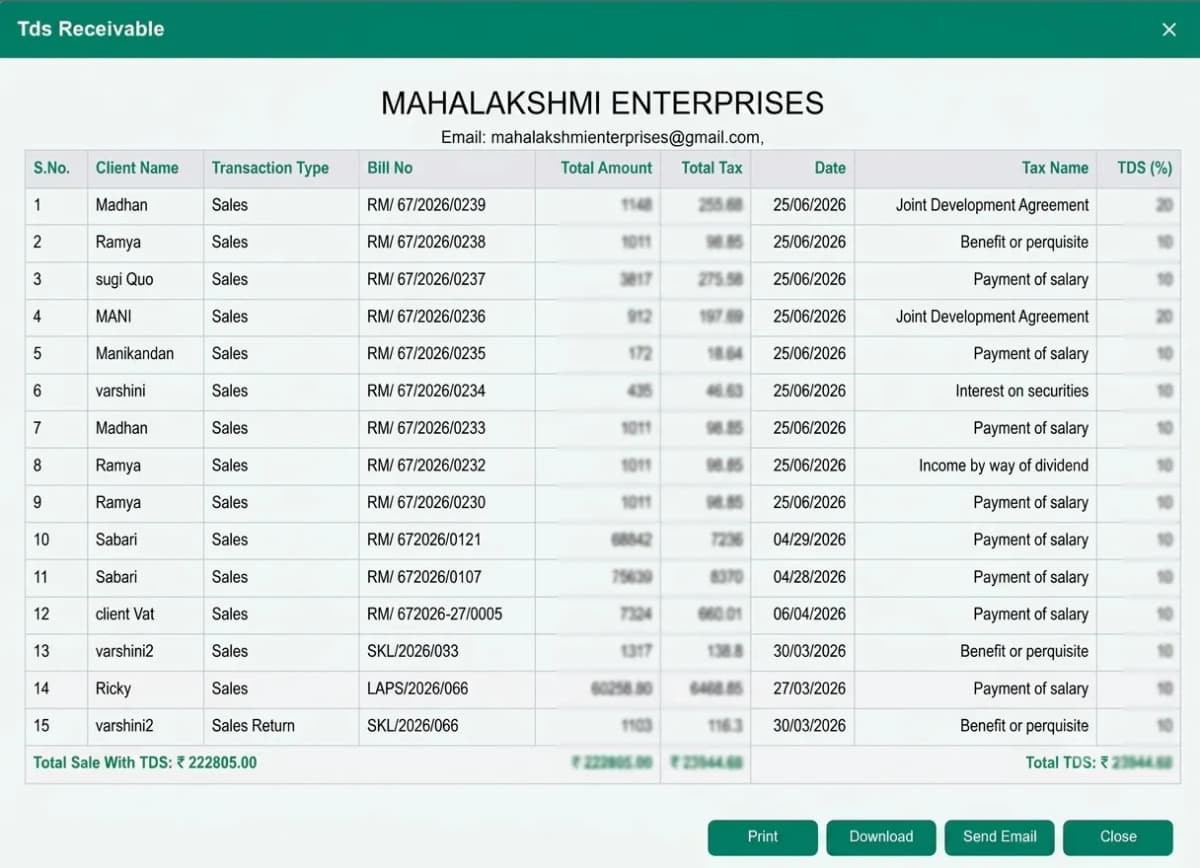
Everything You Need to Manage Billing Easily
Invoice Integration
Seamlessly link TCS amounts with sales invoices and billing records.
Automated TCS Calculation
Accurately compute TCS receivable amounts from each transaction.
Comprehensive Reporting
Generate detailed TCS receivable reports for filing and audits.
Easy Reconciliation
Reconcile TCS collected with customer payments and returns.
Tax Compliance
Ensure compliance with TCS regulations and financial reporting standards.
What is a TCS Receivable Report ?
A detailed financial document that tracks the Tax Collected at Source (TCS) amount receivable from customers on sales invoices. It summarizes TCS liability, collections, adjustments, and pending amounts.
Invoice-Linked TCS Tracking
A TCS Receivable Report consolidates all TCS amounts from sales invoices, GST invoices, and billing transactions. It provides a complete view of TCS collected, pending, refunded, or adjusted against each customer and invoice.
Seamless Reconciliation
With TCS receivable reports, businesses can easily reconcile TCS collected with customer payments, adjust for returns, and prepare for tax filing. It ensures accuracy and reduces manual reconciliation effort significantly.
How to Use a TCS Receivable Report
Follow these steps to maximize the value of your TCS receivable reports
Generate from Invoices
Automatically pull TCS amounts from GST invoices, sales invoices, and billing records. The report aggregates TCS receivable per customer.
Track TCS Status
Monitor the status of each TCS receivable – Collected, Pending, Refunded, or Adjusted – for better cash flow and tax planning.
Reconcile with Payments
Match TCS amounts with actual customer payments. Identify discrepancies and ensure that TCS collected is correctly accounted for.
Prepare for Tax Filing
Use the report to file TCS returns with accurate data. It simplifies tax compliance, reduces errors, and saves time.
Analyze Trends
Review TCS receivable trends over time to identify patterns, improve cash flow, and optimize tax strategies.
Automate with Software
Leverage billing software and accounting tools to automate TCS report generation, reducing manual effort and errors.
Why Businesses Need TCS Receivable Reports
- Ensure Tax Compliance: File accurate TCS returns and avoid penalties.
- Cash Flow Management: Track TCS collection and pending amounts.
- Financial Reporting: Include TCS liabilities in financial statements.
- Audit Readiness: Maintain detailed records for tax audits.
- Customer Transparency: Provide clear TCS breakdowns on invoices.
- Data-Driven Decisions: Use TCS data for strategic planning.
Key Benefits of TCS Reporting
- Save Time: Automate TCS tracking and report generation.
- Reduce Errors: Eliminate manual calculation mistakes.
- Better Record Keeping: Maintain organized TCS records.
- Professional Invoicing: Include TCS details on GST invoices.
- Seamless Reconciliation: Match TCS with payments easily.
- Improved Financial Control: Gain full visibility into TCS.
Key Components of a TCS Receivable Report
Essential elements that make up a comprehensive TCS receivable report
Invoice Details
Each TCS entry is linked to a specific invoice number, date, and customer name for easy cross-referencing.
TCS Rate & Amount
Clearly shows the applicable TCS rate and the TCS amount calculated on the invoice value.
Status Tracking
Current status of each TCS receivable: Collected, Pending, Refunded, or Adjusted.
Due Dates
Due dates for TCS payment to the government, helping you manage compliance deadlines.
Customer Information
Detailed customer information, including PAN and GSTIN, for accurate reporting.
Adjustment Entries
Records of any adjustments, refunds, or credit notes impacting TCS receivable.
How TCS Receivable Reports Support Financial Analysis & Decision-Making
Informed Tax Planning
TCS receivable reports provide the data needed for effective tax planning. By showing TCS collected and pending, businesses can estimate their tax liability accurately and plan for quarterly tax payments, avoiding surprises during filing.
Strategic Resource Allocation
For financial decision-making, TCS receivable reports highlight cash flow patterns and customer payment behaviors. This insight helps businesses optimize working capital, negotiate better payment terms, and allocate resources more effectively.
Best Practices for Accurate TCS Receivable Management
Follow these best practices to ensure your TCS receivable reports are accurate and effective
Automate Data Entry
Use billing software to automatically capture TCS amounts from invoices, reducing manual errors.
Regular Reconciliation
Reconcile TCS collected with customer payments monthly to identify and resolve discrepancies early.
Maintain Supporting Documents
Keep copies of all GST invoices, sales invoices, and payment receipts for audit purposes.
Stay Updated on TCS Rates
Monitor changes in TCS rates and thresholds to ensure correct calculation and compliance.
Use Professional Accounting Software
Leverage accounting software that integrates TCS reporting with your overall financial management.
Train Your Team
Ensure your finance and accounting teams understand TCS regulations and reporting requirements.
Understanding TCS Receivable Reports for Business Growth
How TCS reporting drives sustainable business growth
TCS receivable reports are essential for business growth as they provide the transparency needed to manage tax compliance, optimize cash flow, and build trust with customers. By accurately tracking TCS on sales invoices, businesses can avoid penalties, improve financial reporting, and maintain a professional image.
Driving Business Growth with TCS Receivable Reports
TCS receivable reports are transformative tools that help businesses manage tax compliance and financial reporting with ease. By providing a clear view of TCS collected, pending, and adjusted, these reports enable better cash flow management, reduce audit risk, and enhance overall financial control. For businesses looking to scale, accurate TCS reporting builds trust with customers and tax authorities, creating a foundation for sustainable growth.
Enhancing Tax Compliance
TCS receivable reports ensure that your business stays compliant with TCS regulations. By tracking TCS on every invoice, you can file accurate returns, avoid penalties, and maintain a clean tax record. This is especially critical for businesses dealing with high-value transactions and multiple customers.
Improving Cash Flow Management
With detailed TCS receivable reports, you can forecast cash flow more accurately. Knowing which TCS amounts are collected and which are pending helps you plan for tax payments and optimize your working capital. This insight is invaluable for financial planning and business stability.
Streamlining Audit Processes
Automated TCS receivable reports maintain a clear trail of all tax-related transactions. This makes it easy to respond to auditor queries, provide supporting documents, and demonstrate compliance. A well-organized TCS report can significantly reduce the time and stress involved in tax audits.
Building Customer Trust
Including TCS details on invoices demonstrates transparency and professionalism. Customers appreciate knowing exactly how much TCS is being collected on their transactions. This builds trust and strengthens business relationships, which is essential for long-term growth.
Gaining Competitive Advantage
Businesses that use automated TCS reporting tools are more efficient and accurate than those relying on manual processes. This efficiency translates to faster reporting, fewer errors, and better decision-making, giving you a competitive edge in your industry.
Effective TCS receivable reporting is the backbone of tax compliance and financial control, enabling businesses to track tax collections, ensure accuracy, and drive sustainable growth.