GSTR-3B
Summary Report Simplified
Manage your GSTR-3B summary report with ease. Track monthly tax liabilities, reconcile input tax credits, and ensure timely compliance with GST regulations. Get a comprehensive view of your tax position and make informed decisions.
Tax Compliance
Stay compliant
Auto-reconciliation
Smart matching
Real-time Reports
Instant insights
Audit Ready
Secure records
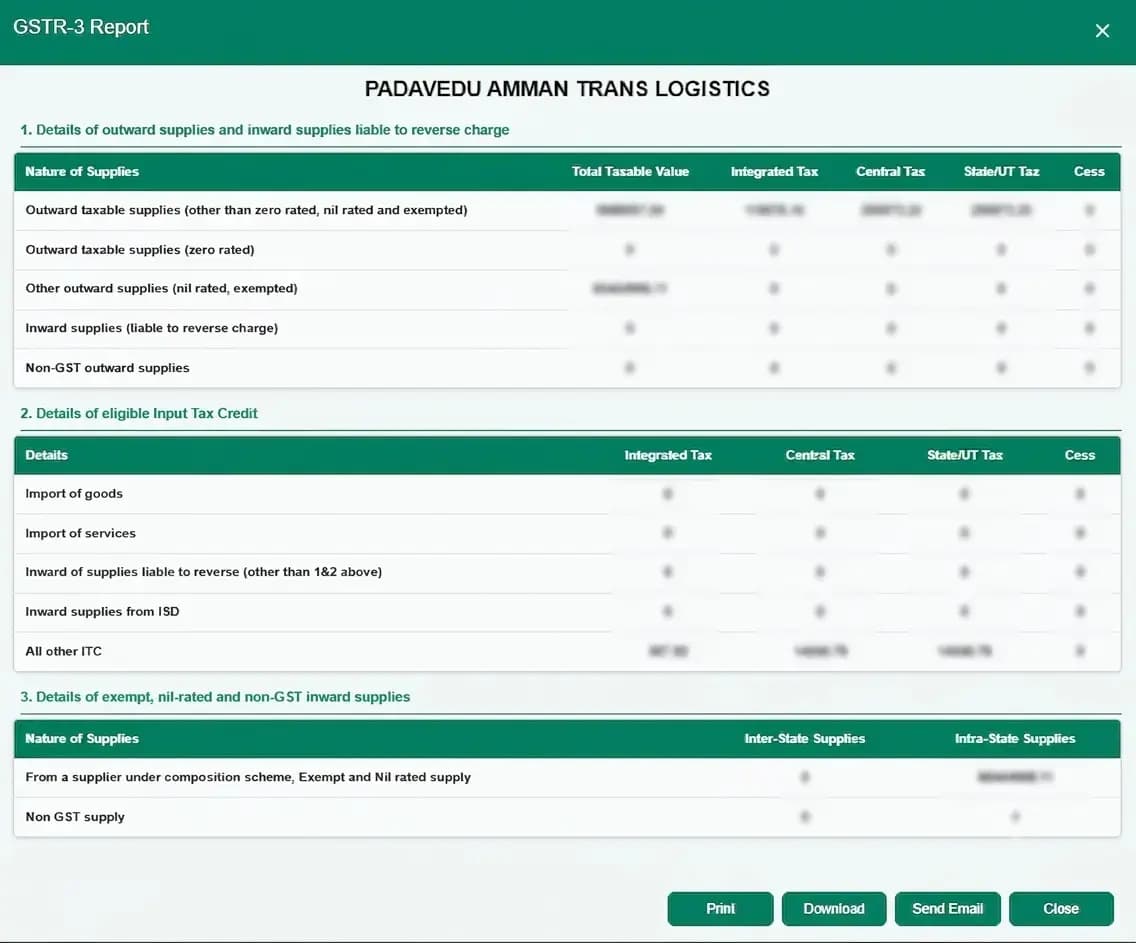
Everything You Need to Manage GST Compliances Efficiently
GSTR-3B Summary
Consolidated monthly return summary with tax liability details.
Compliance Check
Ensure timely filing and avoid penalties.
Return Reconciliation
Match GSTR-3B with GSTR-1 & GSTR-2A.
Tax Liability Analysis
Track output tax, input tax credit, and net liability.
Audit Ready
Maintain accurate records for GST audits.
Master Your GSTR-3B Summary Report
The GSTR-3B summary report is a simplified monthly return filed by registered taxpayers under GST. It provides a consolidated summary of all outward supplies, inward supplies, and the net tax liability for the month. This report is crucial for ensuring tax compliance, avoiding penalties, and maintaining accurate financial records for your business.
For businesses, the GSTR-3B summary report serves as a vital tool for tax planning and financial analysis. It helps you track your output tax liability, claim input tax credits, and reconcile your tax payments with the government's records. By maintaining an accurate GSTR-3B summary, you can identify discrepancies early, avoid interest and penalties, and ensure smooth GST compliance.
Key Components of GSTR-3B Summary Report
Output Tax Liability
Tax payable on all outward supplies made during the month. This includes CGST, SGST, and IGST collected from customers. Accurate tracking ensures correct tax payment.
Input Tax Credit (ITC)
Tax paid on purchases and expenses that can be claimed as credit. ITC reduces the net tax liability and is essential for avoiding cascading tax effects.
Net Tax Liability
The difference between output tax and input tax credit. This is the amount that needs to be paid to the government each month.
Late Payment Interest
Interest charged on delayed tax payments. Timely filing of GSTR-3B helps avoid additional interest and penalties.
Reconciliation Status
Comparison of GSTR-3B with GSTR-1 and GSTR-2A to ensure consistency in reported data across all returns.
Return Filing Status
Track whether the GSTR-3B has been filed, is pending, or is in draft mode. Helps ensure timely compliance.
Why GSTR-3B Summary Report is Critical
Effective GSTR-3B management directly impacts your business tax compliance and financial health:
- Tax Compliance: Ensure timely and accurate GST filing to avoid penalties and legal consequences.
- ITC Optimization: Maximize input tax credit claims by reconciling with purchase records.
- Cash Flow Management: Plan tax payments in advance to maintain healthy cash flow.
- Audit Readiness: Maintain organized records for smooth GST audits.
- Financial Transparency: Get a clear view of your tax position and financial obligations.
- Reduced Errors: Automated reconciliation reduces manual errors in tax calculations.
- Decision Making: Make informed decisions based on accurate tax data.
- Business Reputation: Build trust with stakeholders through consistent compliance.
Best Practices for GSTR-3B Summary Report
Monthly Reconciliation
Reconcile GSTR-3B with GSTR-1 and GSTR-2A monthly to ensure consistency across all returns and identify discrepancies early.
Timely Filing
File GSTR-3B by the 20th of the following month to avoid late fees, interest, and penalties.
ITC Verification
Verify all input tax credit claims against purchase invoices and GSTR-2A to prevent mismatches.
Accurate Bookkeeping
Maintain proper records of all sales and purchases to ensure accurate data entry in GSTR-3B.
Automated Tools
Use GST software to automate GSTR-3B preparation, reduce manual errors, and save time.
Professional Review
Have a tax professional review your GSTR-3B before filing to catch errors and ensure compliance.
Take Control of Your GST Compliance
Understanding and managing your GSTR-3B summary report is essential for maintaining GST compliance and ensuring your business avoids costly penalties. With the right tools and insights, you can streamline your tax filing process, optimize your input tax credit claims, and build a compliant business that can focus on growth. Start managing your GSTR-3B summary effectively today and unlock the full potential of your business's tax efficiency.
Understanding GSTR-3B for Business Growth
A GSTR-3B summary report is one of the most critical compliance documents for any GST-registered business, providing a comprehensive summary of tax liabilities and input tax credits for a given month. Unlike other GST returns, GSTR-3B offers a simplified format with fewer details, making it easier for businesses to file quickly while still maintaining accurate tax records. Modern GST software automates the preparation of GSTR-3B, providing real-time visibility into your tax position and supporting better financial management.
01. Understanding Output Tax Liability
Output tax liability represents the total GST collected on all outward supplies made during the month. This includes sales to both registered and unregistered customers. By tracking output tax accurately, businesses can ensure they are collecting the correct amount of tax from customers and remitting it to the government on time. Regular monitoring helps identify any discrepancies in tax rates or calculations.
02. Managing Input Tax Credit (ITC)
Input tax credit is the GST paid on purchases and expenses that can be claimed as credit against output tax liability. Proper ITC management ensures businesses can claim all eligible credits, reducing their net tax liability. This requires careful reconciliation of purchase invoices with GSTR-2A and GSTR-2B to ensure accuracy.
03. Net Tax Liability Calculation
The net tax liability is the difference between output tax and input tax credit. This is the amount that needs to be paid to the government each month. Accurate calculation ensures businesses pay the correct amount of tax, avoiding interest and penalties. Regular review of net liability helps with cash flow planning.
04. Reconciliation with Other Returns
GSTR-3B must be reconciled with GSTR-1 (outward supplies) and GSTR-2A (inward supplies) to ensure consistency across all returns. Any discrepancies can lead to notices from tax authorities. Regular reconciliation helps identify and correct errors before they become compliance issues.
05. Using Technology for GST Compliance
Modern GST compliance software provides powerful tools for automating GSTR-3B preparation, generating accurate summaries, and ensuring timely filing. These solutions integrate with accounting systems and GST portals to provide a comprehensive view of your tax position. By leveraging technology, businesses can reduce manual errors, save time, and ensure consistent compliance with GST regulations.
✓ Effective GSTR-3B management is the foundation of GST compliance, enabling businesses to optimize tax efficiency, avoid penalties, and achieve long-term financial stability.