Ledger Report
Track Every Financial Transaction
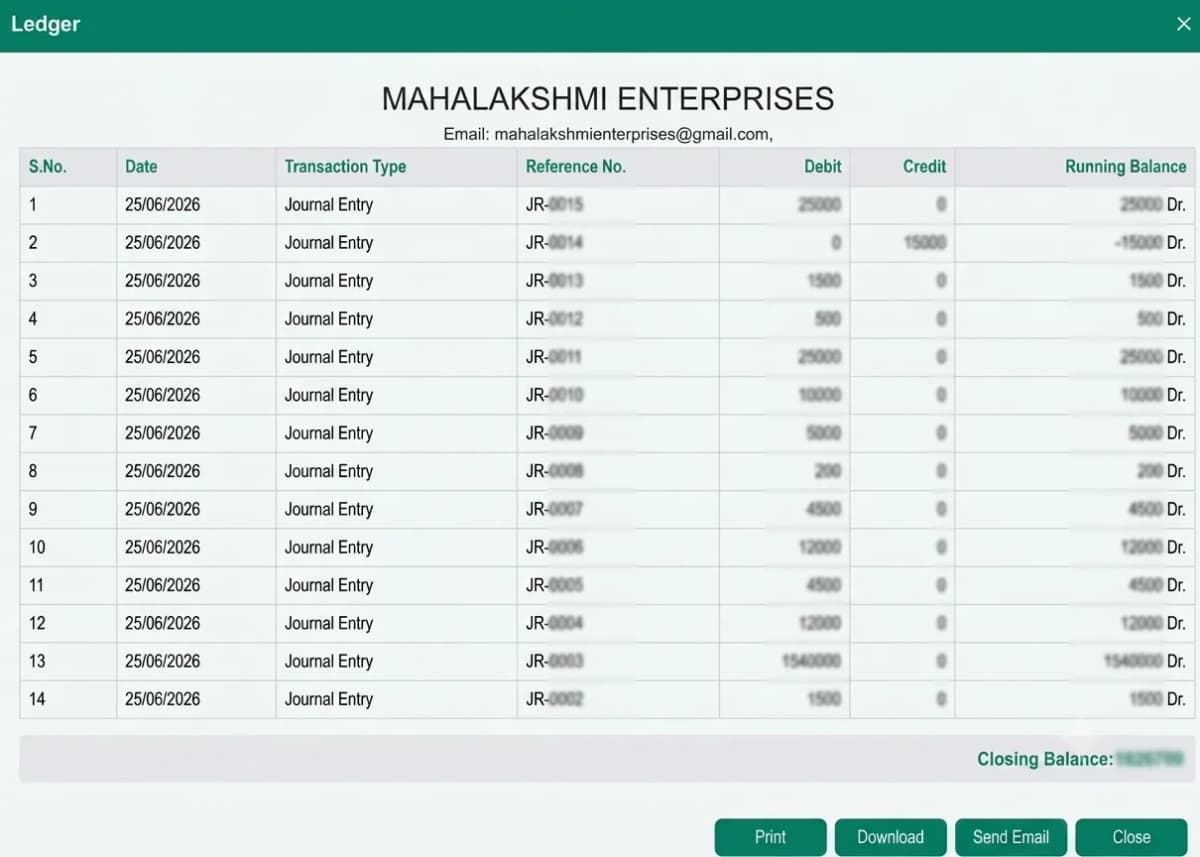
A comprehensive ledger report provides a complete record of all financial transactions in your business. Monitor debits and credits, track account balances, and maintain accurate financial records for better decision-making and compliance.
Complete Records
All transactions
Real-time Tracking
Live updates
Quick Search
Find entries fast
Secure & Compliant
Audit-ready
Everything You Need to Manage Ledger Reports Efficiently
Complete Ledger View
Access all financial transactions in one place.
Transaction Tracking
Monitor every debit and credit with ease.
Balance Management
Track account balances in real-time.
Audit Trail
Complete transaction history for compliance.
Advanced Search
Quickly find any transaction or entry.
Master Your Ledger Report Management
📊 What is a Ledger Report?
A ledger report is a comprehensive financial document that records all transactions in a business, organized by account. It serves as the foundation of the double-entry accounting system, showing every debit and credit entry across all accounts. The general ledger is the master record that contains all the financial transactions, while a ledger report provides a summarized view of these transactions, making it easier to analyze financial activity and ensure accuracy.
Unlike a cash flow statement that focuses on cash movements, a ledger report provides a complete picture of all financial activities, including non-cash transactions, accruals, and adjustments. It is the primary source of information for preparing financial statements like the balance sheet and income statement.
📝 How to Use a Ledger Report
- Review Account Balances: Check the current balance of each account to understand your financial position.
- Track Transaction History: Review all transactions for a specific account to identify patterns or discrepancies.
- Verify Accuracy: Ensure all transactions are properly recorded and categorized for accurate financial reporting.
- Prepare Financial Statements: Use ledger data to create balance sheets, income statements, and cash flow reports.
- Audit and Compliance: Maintain a complete audit trail for regulatory compliance and internal audits.
🎯 Why Businesses Need a Ledger Report
- Financial Accuracy: Ensure all transactions are correctly recorded and accounted for.
- Regulatory Compliance: Maintain proper records for tax purposes and regulatory requirements.
- Decision Making: Make informed business decisions based on accurate financial data.
- Fraud Prevention: Detect and prevent fraudulent activities through transparent record-keeping.
- Growth Planning: Use historical data to plan for future growth and expansion.
✨ Key Benefits of Using a Ledger Report
- Complete Financial Visibility: Get a comprehensive view of all financial transactions across your business.
- Accurate Record-Keeping: Maintain precise and organized financial records for easy reference.
- Time Efficiency: Save time by having all financial information organized in one place.
- Better Financial Control: Monitor spending patterns and identify areas for improvement.
- Enhanced Decision-Making: Use accurate data to make strategic financial decisions with confidence.
Important Components of a Ledger Report
Account Information
Each account in the ledger is identified by a unique account number and name, organized by account type (assets, liabilities, equity, revenue, expenses).
Transaction Details
Each transaction includes the date, description, debit amount, credit amount, and reference number for complete tracking.
Running Balance
The cumulative balance after each transaction, showing the current financial position of each account in real-time.
Debit & Credit Columns
Separate columns for debits and credits following the double-entry accounting system, ensuring every transaction is properly balanced.
Period Summary
Summary information for the selected period, including opening balance, total debits, total credits, and closing balance.
Audit Trail
Complete history of all changes, including who made the entry, when it was made, and any modifications for compliance.
How Ledger Reports Help in Financial Analysis
- Trend Analysis: Identify financial patterns and trends over time to make better predictions.
- Performance Metrics: Calculate key financial ratios and metrics using accurate ledger data.
- Budget Variance: Compare actual spending against budgets to identify areas of concern.
- Cash Flow Analysis: Understand cash movements through detailed transaction records.
- Profitability Assessment: Determine the profitability of different business segments and operations.
- Risk Management: Identify potential financial risks and take proactive measures.
- Strategic Planning: Use historical data to plan for future growth and expansion.
- Investor Reporting: Provide accurate financial information to investors and stakeholders.
Best Practices for Maintaining Accurate Ledger Reports
Regular Reconciliation
Reconcile accounts monthly to ensure all transactions are accurately recorded and accounts are balanced.
Document Every Transaction
Maintain supporting documentation for every entry to ensure accuracy and facilitate audits.
Use Standardized Categories
Organize transactions using standardized account categories for consistency and easy reporting.
Regular Reviews
Conduct periodic reviews of ledger entries to identify and correct errors promptly.
Implement Controls
Establish internal controls to prevent errors and fraud in financial record-keeping.
Use Accounting Software
Leverage modern accounting software to automate ledger management and reduce manual errors.
Understanding Ledger Reports for Business Growth
A well-maintained ledger report is the foundation of financial success. It provides the accurate data needed to understand your business's financial health, make informed decisions, and plan for future growth. By maintaining proper ledger records, you can identify opportunities, manage risks, and build a strong financial foundation for your business.
Mastering Ledger Reports for Financial Excellence
A ledger report is more than just a record of transactions – it's a powerful tool for understanding your business's financial health and driving growth. By maintaining accurate and comprehensive ledger records, you gain complete visibility into your financial operations, enabling you to make smarter decisions, optimize performance, and achieve your business goals.
01. Foundation of Financial Management
Ledger reports serve as the foundation of all financial management activities. They provide the raw data needed to prepare financial statements, track performance metrics, and ensure compliance with regulatory requirements. A well-organized ledger enables businesses to maintain accurate records, reduce errors, and make informed decisions based on reliable financial information.
02. Driving Business Growth
Accurate ledger reports are essential for identifying growth opportunities and potential challenges. By analyzing transaction patterns and account balances, businesses can identify areas of strength, optimize operations, and allocate resources more effectively. Ledger reports also provide the historical data needed for forecasting and strategic planning.
03. Risk Management and Control
Ledger reports play a crucial role in risk management by providing a complete audit trail of all financial transactions. This transparency helps prevent fraud, identify errors, and ensure compliance with financial regulations. Regular review of ledger reports enables businesses to detect unusual activity early and take corrective action.
04. Optimizing Financial Performance
By maintaining accurate ledger records, businesses can optimize their financial performance through better cash management, expense control, and revenue optimization. Ledger reports provide insights into spending patterns, revenue streams, and profitability, enabling businesses to make data-driven decisions that improve bottom-line performance.
05. Future-Proofing Your Business
In today's fast-paced business environment, having accurate and accessible financial records is essential for staying competitive. Modern ledger management systems provide real-time visibility, advanced analytics, and seamless integration with other business systems, enabling businesses to adapt quickly to changing market conditions and maintain financial stability.
✓ Effective ledger report management is essential for financial accuracy, regulatory compliance, and business growth. By maintaining proper records and leveraging modern technology, you can build a strong financial foundation for long-term success.