Journal Report
Complete Financial Transaction Record
A journal report provides a chronological record of all financial transactions, documenting every debit and credit entry. This essential accounting tool ensures accurate bookkeeping, supports financial analysis, and maintains transparency in your business operations.
Accurate Records
Double-entry
Audit Trail
Full transparency
Real-time Entry
Instant logging
Secure Data
Protected
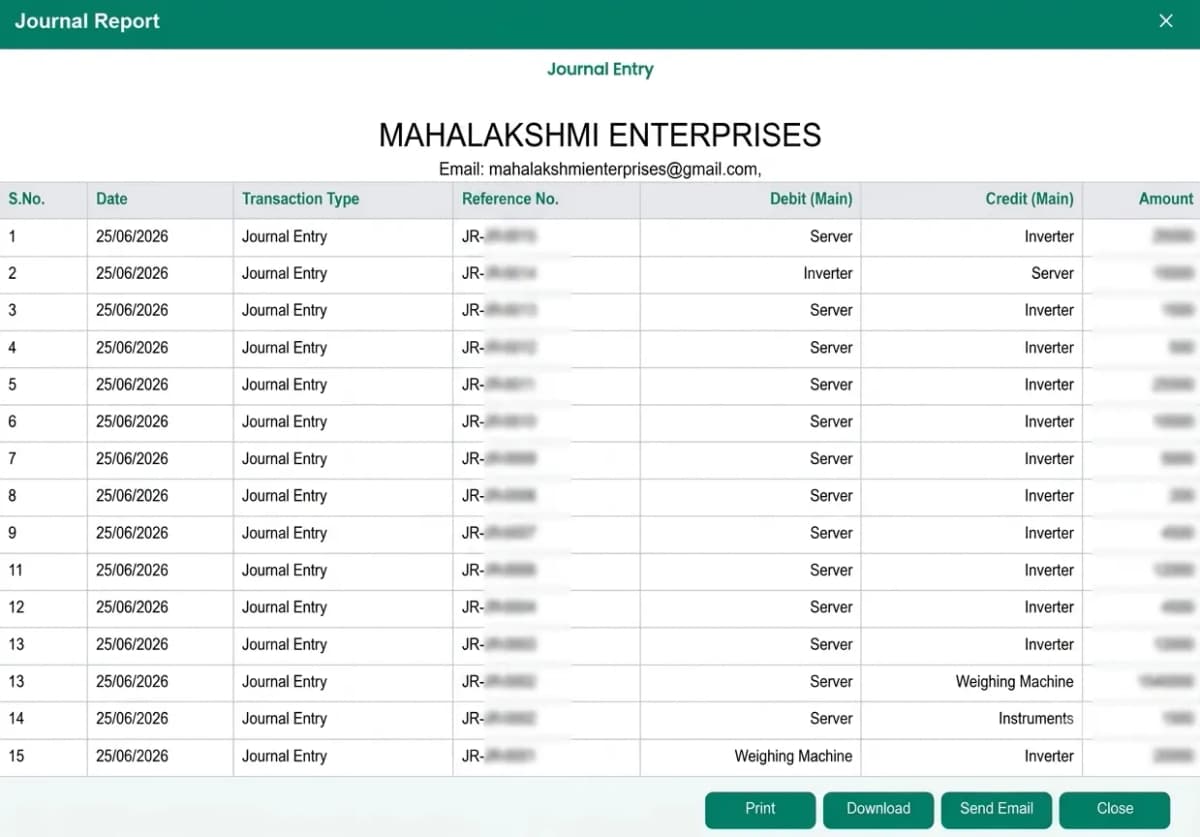
Everything You Need for Accurate Journal Reporting
Journal Entry Management
Record and track all financial transactions in a structured journal format.
Transaction Logging
Maintain a complete chronological record of all business transactions.
Audit Trail
Built-in audit trail for compliance and financial transparency.
General Ledger Integration
Seamlessly link journal entries to your general ledger accounts.
Custom Reports
Generate detailed journal reports for analysis and review.
Understanding the Journal Report
What is a Journal Report?
A journal report is a comprehensive accounting document that records all financial transactions in chronological order, following the double-entry bookkeeping system. Each entry includes the transaction date, accounts affected, debit and credit amounts, and a brief description.
Why It Matters
Unlike other financial reports that summarize data, the journal report provides detailed transaction-level information, making it invaluable for auditing, financial analysis, and ensuring the accuracy of your general ledger.
Key Components of a Journal Report
Transaction Date
Records the exact date when the transaction occurred, ensuring chronological accuracy.
Account Names
Specifies accounts affected by the transaction for double-entry bookkeeping.
Debit & Credit Amounts
Shows monetary values with debits increasing assets/expenses and credits increasing liabilities/equity.
Transaction Description
Brief explanation of each transaction for easy understanding and auditing.
Reference Numbers
Includes invoice numbers or identifiers linking entries to source documents.
Posting Status
Indicates if entry is posted to ledger, in draft, or pending approval.
How to Use a Journal Report Effectively
The journal report serves as the foundation for all financial recordkeeping. Here's how to use it effectively:
Why Every Business Needs a Journal Report
Accurate Financial Records
Maintain precise records reflecting all business transactions accurately.
Compliance & Auditing
Meet regulatory requirements with a transparent transaction history.
Financial Analysis
Support analysis and decision-making with detailed transaction data.
Error Detection
Identify and correct errors quickly through systematic review.
Tax Preparation
Simplify tax preparation with organized transaction records.
Business Valuation
Support business valuation with accurate historical data.
Key Benefits of Using a Journal Report
Best Practices for Maintaining Accurate Journal Reports
Timely Recording
Record transactions as they occur to maintain accuracy and prevent data loss.
Detailed Documentation
Include clear descriptions and reference numbers for each journal entry.
Regular Reconciliation
Reconcile journal entries with bank statements and other source documents.
Review and Approval
Implement review and approval processes before posting to the ledger.
Segregation of Duties
Separate responsibilities for recording, reviewing, and approving entries.
Use of Technology
Leverage accounting software for automated entries and improved accuracy.
Understanding Journal Reports for Business Growth
A journal report is more than just a record-keeping tool—it's a strategic asset for business growth and financial management. By maintaining accurate and detailed journal entries, businesses gain unprecedented visibility into their financial operations, enabling better decision-making and strategic planning.
Transaction-Level Financial Analysis
The journal report provides granular, transaction-level data that enables detailed financial analysis. By examining individual entries, businesses can identify spending patterns, revenue trends, and potential inefficiencies. This detailed visibility supports more accurate forecasting and helps businesses optimize their financial operations for better profitability.
Audit Readiness and Compliance
A well-maintained journal report ensures your business is always audit-ready. With complete documentation of all financial transactions, you can demonstrate compliance with accounting standards and regulatory requirements. This is particularly important for businesses seeking funding, preparing for tax audits, or maintaining investor confidence.
Strategic Decision-Making Support
Accurate journal entries provide the foundation for informed decision-making. Whether you're evaluating new investments, assessing operational costs, or planning expansion strategies, having reliable transaction data allows you to make decisions based on facts rather than assumptions.
Business Valuation and Due Diligence
For businesses seeking investment or preparing for sale, a comprehensive journal report demonstrates financial transparency and operational maturity. Investors and acquirers value businesses with well-documented financial records, as it reduces risk and instills confidence in the accuracy of financial reporting.
Technology-Enabled Journal Management
Modern accounting software has revolutionized journal entry management, automating repetitive tasks and reducing human error. Features like bank feeds, automated categorization, and real-time synchronization ensure that journal entries are always accurate and up-to-date. By embracing technology, businesses can focus more on analysis and strategy rather than manual data entry.
An accurate journal report is the cornerstone of financial integrity, enabling businesses to maintain transparency, ensure compliance, and drive sustainable growth through informed financial management.