Proforma Invoice
Guide vs Final Invoices
Understand the crucial differences between proforma invoices and final invoices. Learn when to use each type, how they impact your business, and how to choose the right format for your transaction needs.
Easy Estimates
Professional quotes
Quick Conversion
Proforma to final
GST Compliant
Final invoices
Legal Protection
Clear documentation
Everything You Need for Professional Invoicing Success
Proforma Invoices
Create estimates and quotes professionally.
Final Invoices
Generate GST-compliant final invoices.
Easy Conversion
Convert proforma to final invoices instantly.
Professional Templates
Customizable templates for both types.
Side-by-Side Comparison
Understand key differences clearly.
Complete Guide to Proforma Invoices vs Final Invoices
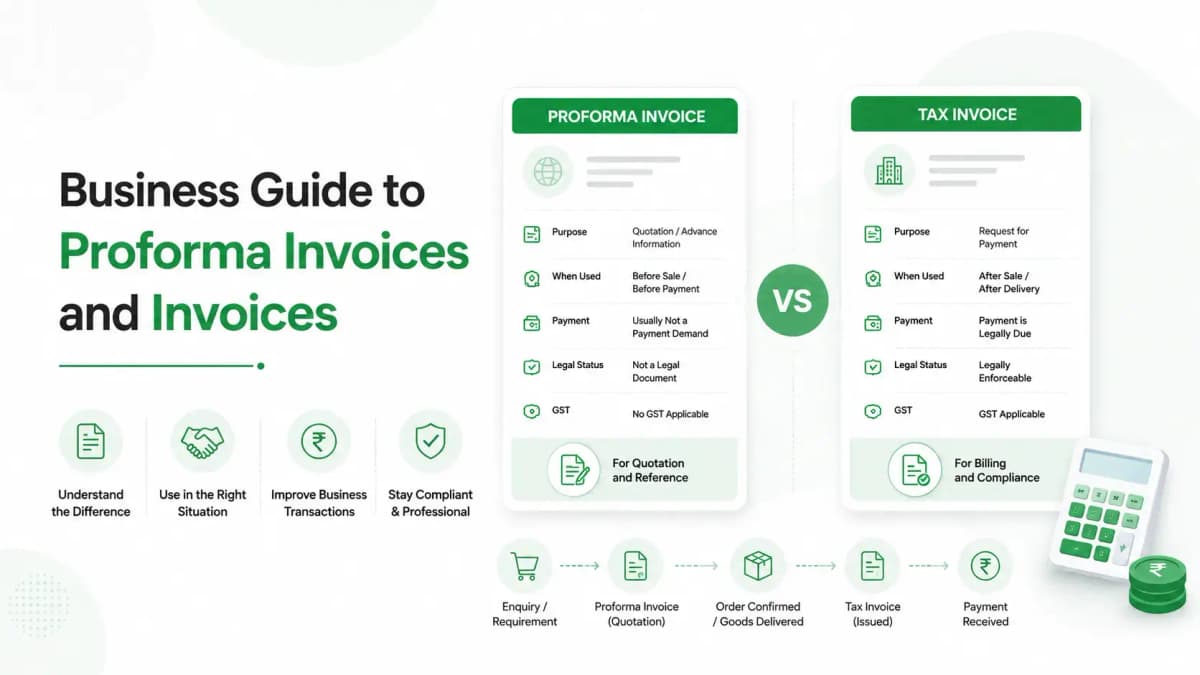
Understanding the difference between proforma invoices and final invoices is essential for effective business operations. A proforma invoice is a preliminary bill of sale sent to buyers before delivery of goods or services, while a final invoice is a legal document requesting payment after the transaction is complete[citation:1][citation:2].
Both types serve different purposes in the business process. Proforma invoices are non-binding estimates used for quotes and customs, while final invoices are legally binding documents that serve as official payment requests and tax records[citation:1][citation:4]. Knowing when and how to use each is crucial for business success.
Key Differences Between Proforma and Final Invoices
Proforma Invoice
Purpose
Quote / preview / commitment document[citation:1]
Legal Status
Non-binding estimate, no legal obligation[citation:4]
Tax & Accounting
No tax obligation, not recorded in books[citation:1][citation:2]
Timing
Sent before transaction is finalized[citation:4]
Final Invoice
Purpose
Official demand for payment[citation:1]
Legal Status
Legally binding, creates payment obligation[citation:1][citation:6]
Tax & Accounting
Triggers tax obligation, recorded in accounts[citation:1]
Timing
Sent after goods/services delivered[citation:4]
When to Use Each Type of Invoice
Choosing the right invoice type is crucial for business efficiency and legal compliance[citation:1][citation:5]:
- Use Proforma Invoices for quotes, estimates, and preliminary cost approvals[citation:5]
- Use Proforma Invoices for international shipments and customs clearance[citation:2][citation:5]
- Use Proforma Invoices to help buyers secure financing or budget approval[citation:9]
- Use Final Invoices for legal payment requests after service delivery[citation:6]
- Use Final Invoices for GST compliance and tax documentation[citation:1]
- Use Final Invoices for official financial records and audits[citation:1]
- Use Final Invoices for claiming input tax credit (ITC) under GST[citation:1]
- Use Final Invoices for accounts receivable and revenue recognition[citation:4]
Key Components of Proforma and Final Invoices
Clear Document Title
Always label 'PROFORMA INVOICE' prominently to prevent confusion with final invoices[citation:5]
Business & Customer Details
Both types require complete seller and buyer information including names, addresses, and contact details[citation:2][citation:11]
Itemized Products/Services
Clear description of products/services, quantities, unit prices, and line totals for transparency[citation:2][citation:5]
Tax Calculations (Final Only)
Final invoices require proper GST calculations (CGST, SGST, IGST) with rates and amounts[citation:1]
Validity Period (Proforma)
Proforma invoices should clearly state validity period, typically 30-90 days[citation:1][citation:9]
Payment Terms & Instructions
Include payment terms, due dates, accepted methods, and bank details for final invoices[citation:2][citation:6]
Benefits of Understanding Both Invoice Types
Understanding Proforma vs Final Invoices for Business Success
A proforma invoice serves as a preliminary document that outlines the terms of a sale before the actual transaction occurs, while a final invoice is the official billing document that requests payment after goods or services are delivered[citation:1][citation:4]. Understanding the distinction is crucial for effective business operations, compliance, and customer relationship management[citation:5].
01. Understanding Proforma Invoices
Proforma invoices are preliminary documents sent to customers before a sale is finalized[citation:2]. They serve multiple purposes including providing cost estimates, facilitating customs clearance for international shipments, and confirming order details[citation:5]. Unlike final invoices, they are non-binding documents that do not require GST calculation, making them ideal for quotes, tenders, and procurement processes[citation:1][citation:4].
02. Understanding Final Invoices
Final invoices are legally binding documents that request payment after goods or services have been delivered[citation:6]. They must include complete GST calculations, unique invoice numbers, payment terms, and all required legal information[citation:1]. Final invoices serve as official financial records, tax documents, and legal proof of transaction[citation:4].
03. Key Differences at a Glance
The main differences include legal status (non-binding vs binding), purpose (estimate vs payment request), GST treatment (no tax vs full tax calculation), and timing (before vs after delivery)[citation:1][citation:4]. Proforma invoices are typically used for quotes and planning, while final invoices are used for billing and legal documentation[citation:2][citation:6].
04. Best Practices for Both Types
Best practices include using professional templates, maintaining sequential numbering, clearly stating terms and conditions, and ensuring accuracy in all calculations[citation:5][citation:11]. For proforma invoices, always include a validity period. For final invoices, ensure full GST compliance with proper tax rates and calculations[citation:1][citation:9].
05. Leveraging Technology for Success
Modern invoicing software makes it easy to create both proforma and final invoices, with features for automatic conversion from proforma to final, GST calculations, and template customization[citation:10]. Technology helps reduce errors, save time, and maintain professional consistency across all your billing documents[citation:5].
✓ Mastering both proforma and final invoices enables you to streamline operations, ensure compliance, and build lasting business relationships[citation:2][citation:5].