Trial Balance Sheet
Ensure Accounting Accuracy
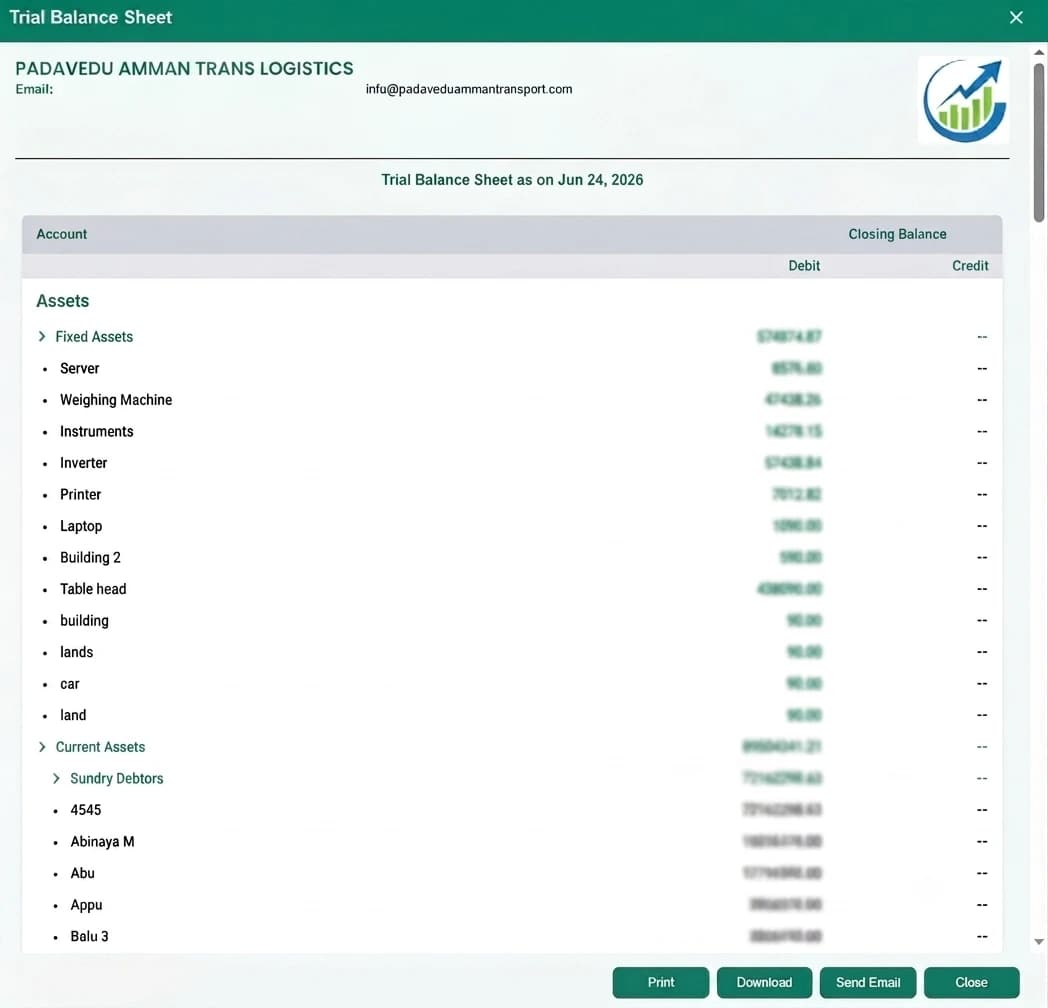
Verify the accuracy of your financial records with a comprehensive Trial Balance Sheet. Track all debit and credit entries from your invoices, detect discrepancies early, and maintain error-free accounting records for reliable financial reporting and business decisions.
Debit & Credit
Verification
Error Detection
Real-time
Invoice Tracking
Accurate
Financial
Integrity
Everything You Need to Manage Billing Easily
Create Invoices
Create professional invoices in seconds.
Manage Clients
Save and manage all your client details.
Track Payments
Track paid, unpaid and overdue invoices.
Reports & Insights
Get business reports and insights instantly.
QR Code Payment
Collect payments quickly with a simple QR scan.
Trial Balance Sheet – Verify Your Financial Records
A Trial Balance Sheet is a critical accounting report that summarizes all general ledger accounts and their debit or credit balances. It ensures that total debits equal total credits, verifying the mathematical accuracy of your bookkeeping records before preparing financial statements.
Every invoice you create—whether a sales invoice or a purchase invoice—directly impacts your Trial Balance. By accurately recording these transactions, you can detect errors, reconcile accounts, and maintain reliable financial data for informed business decisions.
Key Components of a Trial Balance Statement
Account Name
List of all active general ledger accounts, including Cash, Accounts Receivable, Accounts Payable, Revenue, and Expenses.
Account Number
Unique identifier for each account in your chart of accounts, facilitating organized record-keeping.
Debit Balance
Total debits recorded for each account, representing assets, expenses, and costs incurred in business operations.
Credit Balance
Total credits recorded for each account, representing liabilities, equity, and revenue generated by the business.
Total Debits
Sum of all debit balances across all accounts, which should equal total credits for an accurate Trial Balance.
Total Credits
Sum of all credit balances across all accounts, providing the other side of the accounting equation.
Account Type
Classification of each account into categories: Asset, Liability, Equity, Revenue, or Expense accounts.
Running Balance
Current balance of each account, updated after every transaction to maintain real-time accuracy.
Why Your Business Needs a Trial Balance
- Verify mathematical accuracy of accounting records
- Detect errors in journal entries and postings
- Ensure double-entry accounting is correctly applied
- Prepare accurate financial statements with confidence
- Identify discrepancies before finalizing accounts
- Maintain audit trails for compliance purposes
- Streamline the financial reporting process
Key Benefits of Regular Trial Balance Review
- Early detection of posting errors and omissions
- Improved accuracy of financial reports
- Better decision-making with reliable data
- Reduced risk of financial misstatements
- Enhanced internal controls over accounting processes
- Faster month-end and year-end closing
- Increased confidence in financial management
Best Practices for Maintaining an Accurate Trial Balance
Regular Posting
Record all invoice transactions promptly to maintain accurate account balances.
Reconcile Accounts
Regularly reconcile Accounts Receivable and Accounts Payable with customer and supplier statements.
Review for Errors
Check for transposition errors, incorrect account codes, and posting omissions.
Verify Balances
Confirm that total debits equal total credits after each reporting period.
Maintain Documentation
Keep supporting documentation for all entries to facilitate auditing and verification.
Use Billing Software
Leverage automated invoicing and accounting tools to reduce manual errors.
Track Payment Status
Monitor paid, unpaid, and overdue invoices to ensure accurate receivable balances.
Professional Review
Periodically have an accountant review your Trial Balance for accuracy.
How Trial Balance Analysis Drives Better Financial Decisions
Error Detection
Identify and correct accounting errors before they impact financial statements.
Financial Accuracy
Ensure all transactions, including invoices and payments, are properly recorded.
Strategic Planning
Use verified financial data to make informed business and investment decisions.
Trial Balance Sheet – Foundation of Accurate Accounting
A Trial Balance Sheet is the cornerstone of accurate business accounting, providing a complete summary of all debit and credit balances from your general ledger. Every financial transaction, including sales invoices, purchase invoices, and payment entries, directly impacts the Trial Balance and plays a vital role in maintaining accurate financial records. When you create an invoice for products or services, the system automatically records the appropriate debit and credit entries, ensuring that your financial statements always present a true and fair view of your business.
Understanding Trial Balance Sheet
A Trial Balance Sheet is a fundamental accounting report that lists all the general ledger accounts and their respective debit or credit balances at a specific point in time. It serves as the primary tool for verifying the mathematical accuracy of financial records before preparing final financial statements. The fundamental principle underlying a Trial Balance is that total debits must equal total credits, ensuring that every transaction has been recorded with equal and opposite entries in the accounting system.
The Importance of Trial Balance in Accounting
The Trial Balance is essential for maintaining accurate accounting records and ensuring the integrity of your financial data. It helps detect mathematical errors, identifies discrepancies in postings, and verifies that the double-entry accounting system is functioning correctly. Regular Trial Balance preparation enables businesses to catch errors early, streamline the financial reporting process, and maintain confidence in their accounting records. It also serves as the foundation for preparing key financial statements like the Balance Sheet and Profit and Loss Statement.
Key Components of a Trial Balance Statement
A well-prepared Trial Balance includes all active accounts from the general ledger, categorized by account type: Assets, Liabilities, Equity, Revenue, and Expenses. It typically lists each account name, account number, and its debit or credit balance. Common accounts include Cash, Accounts Receivable, Inventory, Accounts Payable, Sales Revenue, and Operating Expenses. The Trial Balance format also includes summary totals for total debits and total credits, which should match if all transactions have been recorded correctly.
How Invoices Impact Your Trial Balance
Every invoice you create directly affects your Trial Balance. When you issue a sales invoice, you record a debit to Accounts Receivable and a credit to Sales Revenue. Similarly, receiving a purchase invoice results in a debit to an expense account and a credit to Accounts Payable. These invoice transactions are recorded in the general ledger and subsequently reflected in the Trial Balance. Accurate invoice management is therefore crucial for maintaining an accurate Trial Balance and ensuring your financial statements present a true and fair view of your business.
How InvoiceFree.in Simplifies Trial Balance Management
InvoiceFree.in streamlines the process of maintaining an accurate Trial Balance by automatically recording all invoice transactions in your general ledger. Our billing software ensures that every sales invoice and purchase invoice is correctly posted with appropriate debit and credit entries. The platform provides real-time accounting reports, including a comprehensive Trial Balance Sheet that you can generate at any time. With automated invoice management and seamless accounting integration, you can reduce errors, save time, and focus on growing your business while maintaining accurate financial records.
✓ Accurate Trial Balance management helps businesses maintain reliable financial records and supports confident decision-making.
A well-maintained Trial Balance Sheet is essential for verifying accounting accuracy, detecting errors, and ensuring reliable financial reporting. By regularly reviewing your Trial Balance and reconciling it with your invoices and accounting records, you can maintain a solid foundation for all your financial operations.
Pro Tip: Combine your Trial Balance review with regular reconciliation of Accounts Receivable and Accounts Payable to ensure all invoice transactions are accurately recorded and your financial statements reflect your business's true financial position.