Profit & Loss
Track Your Business Profitability
Understand your business's financial performance with comprehensive profit and loss reporting. Track revenue, expenses, and profitability trends to make informed decisions and drive sustainable growth.
Revenue Tracking
Real-time updates
Expense Analysis
Smart categorization
Profit Margins
Automated calculation
Secure Data
Bank-grade
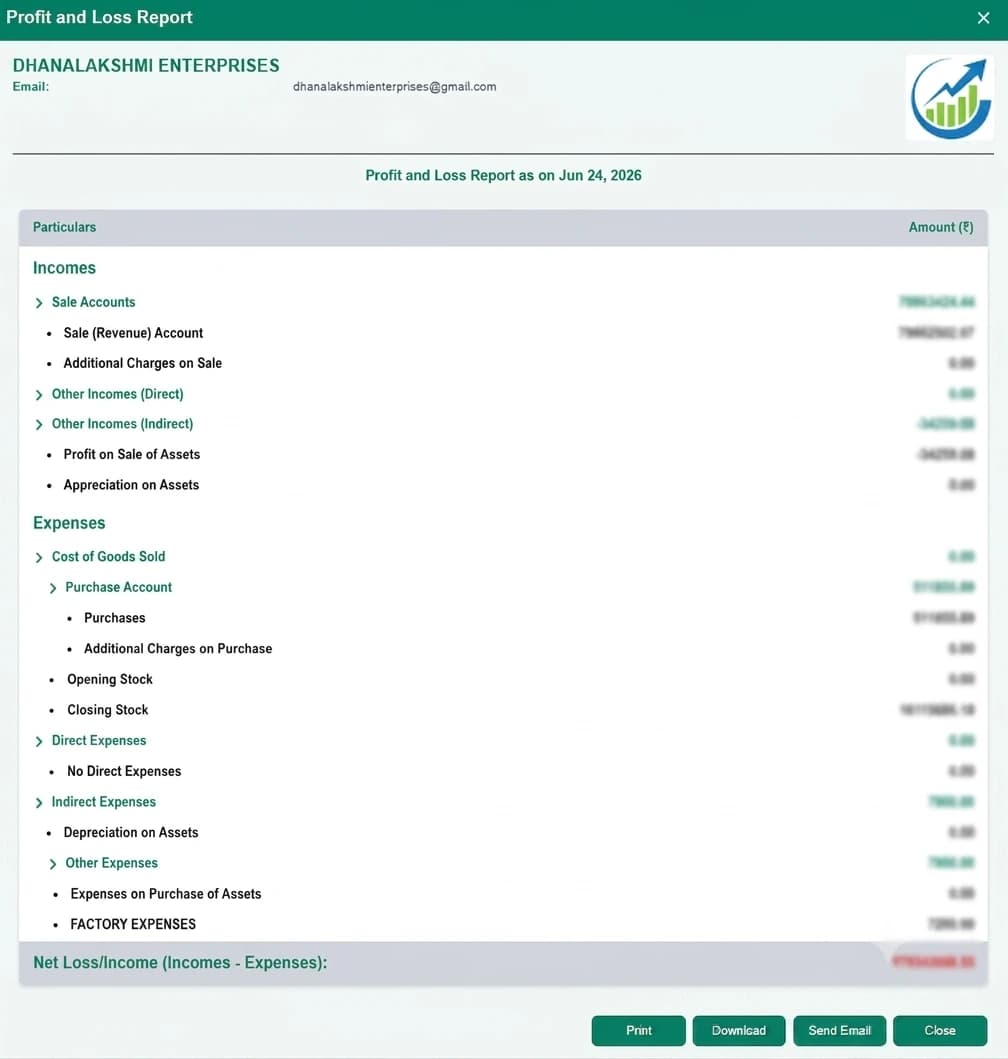
Everything You Need to Manage Profit & Loss Efficiently
Revenue Tracking
Monitor all income streams and sales performance in real-time.
Expense Management
Track and categorize all business expenses efficiently.
Profit Calculation
Calculate gross and net profit margins automatically.
Financial Analysis
Analyze profitability trends and business performance.
Trend Forecasting
Predict future profitability with AI-powered insights.
Master Your Profit & Loss Management
A profit and loss (P&L) statement, also known as an income statement, is a financial report that summarizes the revenues, costs, and expenses incurred during a specific period. This essential financial document provides a clear picture of your business's ability to generate profit by increasing revenue, reducing costs, or both. Understanding your P&L is crucial for financial planning, investor communication, and strategic decision-making.
Whether you're a startup founder or a seasoned business owner, maintaining an accurate P&L statement helps you identify profit drivers, control costs, optimize pricing strategies, and assess the overall financial health of your organization. Regular P&L analysis enables you to make data-driven decisions that enhance profitability and ensure long-term business sustainability.
Key Components of Profit & Loss Statement
Revenue / Income
Total income generated from business operations, including product sales, service fees, and other income streams. This is the top line of your P&L statement and represents the total value of goods or services provided.
Cost of Goods Sold (COGS)
Direct costs associated with producing goods or delivering services, including raw materials, labor, and manufacturing overhead. COGS is subtracted from revenue to calculate gross profit.
Gross Profit
Revenue minus COGS. This metric shows how efficiently your business produces goods or services. Higher gross profit indicates better operational efficiency and pricing strategies.
Operating Expenses
Costs required to run the business that aren't directly tied to production, including rent, utilities, salaries, marketing, and administrative expenses.
Operating Profit / EBITDA
Gross profit minus operating expenses. This indicates the profitability of core business operations before interest and taxes, showing how well the business performs operationally.
Net Profit / Net Income
The bottom line of your P&L statement. Net profit is calculated by subtracting all expenses (including interest and taxes) from total revenue. This represents the actual profit earned by the business.
Why Profit & Loss Management is Critical
Effective P&L management directly impacts your business growth, sustainability, and overall success:
- Track Business Profitability: Monitor actual profits and identify trends in revenue and expenses.
- Identify Cost Saving Opportunities: Pinpoint areas where you can reduce costs and improve efficiency.
- Optimize Pricing Strategies: Analyze profit margins to adjust pricing for maximum profitability.
- Secure Funding and Investment: Present clear financials to attract investors and secure loans.
- Plan for Business Growth: Use P&L insights to make informed decisions about expansion and investment.
- Manage Tax Liability: Maintain accurate records for tax compliance and planning.
- Benchmark Performance: Compare your business's performance against industry standards.
- Communicate Financial Health: Share P&L statements with stakeholders to demonstrate business performance.
Best Practices for P&L Management
Regular P&L Review
Review your P&L statement monthly to track financial performance and identify trends early.
Accurate Expense Categorization
Properly categorize expenses to understand true costs and identify areas for optimization.
Revenue Recognition
Follow consistent revenue recognition practices to accurately reflect income in the correct period.
Budget Comparison
Compare actual results against budgets and forecasts to identify variances and adjust strategies.
Profit Margin Analysis
Monitor gross and net profit margins to assess pricing effectiveness and operational efficiency.
Use Technology Solutions
Automate P&L tracking with modern accounting software for real-time insights and accuracy.
Take Control of Your Business Profitability
Understanding and managing your profit and loss statement is fundamental to business success. By maintaining accurate P&L records and analyzing financial trends, you can optimize profitability, make informed strategic decisions, and build a financially resilient business. Start using comprehensive P&L reporting today to unlock the full financial potential of your enterprise.
Understanding Profit & Loss for Business Growth
A profit and loss statement is more than just a financial document - it's a powerful tool that reveals the financial health and operational efficiency of your business. By analyzing revenues, costs, and expenses over a specific period, the P&L statement provides actionable insights into what's driving your profits and what's holding your business back. Modern accounting software automates the creation and analysis of P&L statements, providing real-time visibility into your profitability and supporting better financial decision-making.
01. Revenue Recognition and Management
Revenue recognition is the foundation of accurate P&L reporting. Understanding when and how to recognize revenue ensures your income statement reflects true business performance. Proper revenue management involves tracking multiple income streams, implementing effective billing cycles, and ensuring timely collection of payments. By maintaining disciplined revenue recognition practices, you can gain a clear picture of your business's earning power and growth trajectory.
02. Cost Control and Expense Management
Effective expense management is essential for maintaining healthy profit margins. This involves categorizing expenses accurately, identifying cost drivers, and implementing cost-control measures. Regular expense analysis helps you identify areas where you can reduce costs without compromising quality or operations. By optimizing your expense structure, you can improve your bottom line and increase overall business profitability.
03. Profit Margin Analysis and Optimization
Profit margins are key indicators of business health and efficiency. Gross margin measures production efficiency, while net margin reflects overall operational effectiveness. Regular profit margin analysis helps you assess pricing strategies, identify inefficiencies, and make data-driven decisions to improve profitability. Understanding your margins is essential for setting competitive prices, managing costs, and ensuring sustainable growth.
04. Financial Planning and Forecasting
P&L statements provide the historical data needed for accurate financial planning and forecasting. By analyzing past performance trends, you can project future revenues, anticipate expenses, and plan for growth. Regular forecasting helps you prepare for seasonal fluctuations, identify potential cash flow challenges, and make proactive decisions to maintain financial stability and support business expansion.
05. Leveraging Technology for P&L Optimization
Modern accounting and financial management software provides powerful tools for automating P&L tracking, generating real-time reports, and performing in-depth financial analysis. These solutions integrate with banking systems, payment platforms, and business applications to provide a comprehensive view of financial performance. By leveraging technology, you can reduce manual errors, save time, and gain deeper insights that drive strategic decision-making and business success.
✓ Effective profit and loss management is the cornerstone of business success, enabling you to optimize profitability, drive growth, and achieve long-term financial stability.