Balance Sheet
Track Your Financial Status
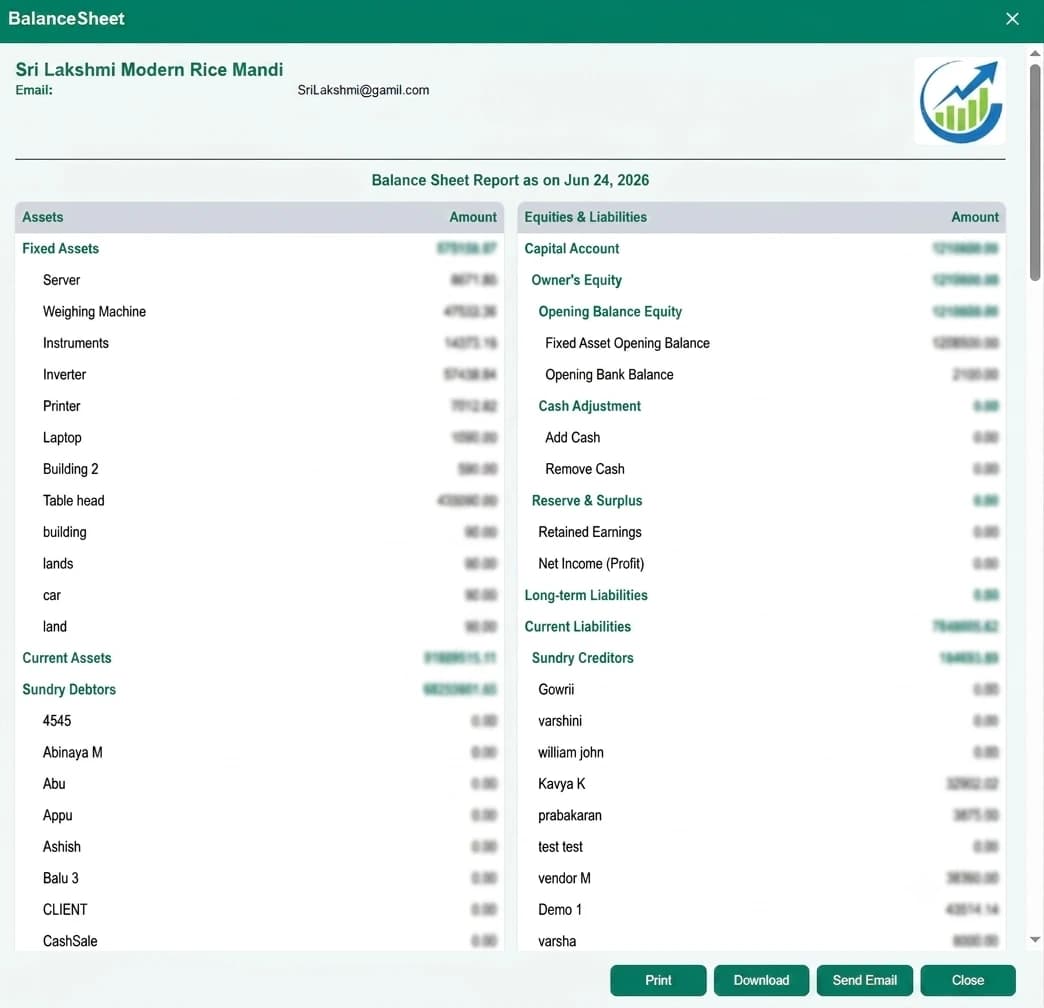
Get a complete overview of your assets, liabilities, and equity. Monitor your financial position with real-time balance sheet insights and make data-driven decisions for your business.
Asset Tracking
Comprehensive
Liability Insights
Real-time
Equity Analysis
Smart Tools
Financial
Security
Everything You Need to Manage Billing Easily
Create Invoices
Create professional invoices in seconds.
Manage Clients
Save and manage all your client details.
Track Payments
Track paid, unpaid and overdue invoices.
Reports & Insights
Get business reports and insights instantly.
QR Code Payment
Collect payments quickly with a simple QR scan.
How Invoices Impact Your Balance Sheet
Every invoice you create directly affects your Balance Sheet. When you raise an invoice for goods or services rendered, it creates a financial transaction that impacts multiple accounts within your financial statements. Understanding this connection is crucial for accurate financial reporting, tax compliance, and maintaining a healthy cash flow.
Invoices are not just payment requests—they are accounting documents that trigger changes in your assets, liabilities, and revenue recognition. Proper invoice management ensures that your Balance Sheet accurately reflects your business's financial position and supports informed decision-making.
Key Balance Sheet Accounts Affected by Invoices
Sundry Debtors / Accounts Receivable
When you issue an invoice on credit, it increases your Sundry Debtors account. These are amounts owed by customers, representing an asset that will convert to cash when payment is received.
Bank & Cash Accounts
When customers pay invoices, the amount credited increases your Bank Account or Cash Account. Regular reconciliation between invoices and bank statements ensures accurate cash position.
Input GST / VAT Receivable
For registered businesses, invoices include GST/VAT components. The input tax credit claimed on purchases creates a receivable that appears as a current asset on your Balance Sheet.
TDS & TCS Receivable
Tax Deducted at Source (TDS) and Tax Collected at Source (TCS) on invoices create temporary receivables. These appear as current assets until adjusted against your final tax liability.
Other Current Assets
Prepayments, deposits, and advances against invoices are recorded as other current assets. These ensure proper matching of expenses with revenue recognition.
Revenue / Income Accounts
While not a Balance Sheet line item, invoice revenue flows into Profit & Loss and ultimately affects Retained Earnings in the equity section—closing the loop between operations and financial position.
Why Accurate Invoice Management is Essential
Professional invoice management directly impacts your Balance Sheet accuracy and overall financial health:
- Real-time Receivable Tracking: Monitor unpaid invoices to maintain healthy cash flow and reduce Days Sales Outstanding (DSO).
- Tax Compliance: Accurately record GST/VAT, TDS, and TCS components to avoid penalties and ensure correct tax reporting.
- Asset Classification: Properly categorize receivables as current assets based on their expected collection timeline.
- Liability Management: Track outstanding payables against invoices to maintain a true picture of financial obligations.
- Revenue Recognition: Ensure revenue is recorded in the correct accounting period, maintaining the accuracy of retained earnings.
- Audit Trail: Maintain clear invoice documentation for statutory audits, investor reviews, and financial due diligence.
Best Practices for Invoice & Balance Sheet Integration
Regular Reconciliation
Reconcile invoice data with bank statements at least weekly to ensure receivables accurately reflect actual payments received.
Timely Invoice Generation
Generate invoices promptly upon delivery of goods or services to maintain accurate receivable aging and cash flow projections.
Clear Payment Terms
Define payment terms (e.g., Net 15, Net 30) on invoices to manage expected collection dates and classify receivables correctly.
Automated Tracking
Use accounting software that automatically updates Balance Sheet accounts when invoices are created, modified, or paid.
Tax Compliance
Ensure all statutory taxes (GST, TDS, TCS) are correctly calculated and recorded against each invoice for accurate liability reporting.
Periodic Review
Review aging reports regularly to identify overdue invoices and take proactive collection measures.
Take Control of Your Financial Position
Every invoice you issue tells a story about your business's financial health. By maintaining accurate invoices and understanding their impact on your Balance Sheet, you gain full visibility into your assets, liabilities, cash flow, and tax positions. This empowers you to make data-driven decisions, plan for growth, and present a credible financial picture to stakeholders, lenders, and regulatory authorities.
How Invoices Impact Your Balance Sheet
A Balance Sheet is one of the most important financial statements for any business, providing a clear overview of assets, liabilities, and equity at a specific point in time. Every invoice generated through an invoice generator directly affects business accounting records and plays a significant role in maintaining accurate financial data. When a business issues a GST invoice for products or services, the invoice amount is typically recorded under accounts receivable, increasing current assets until the payment is received. This process helps businesses maintain accurate balance sheet records and supports effective financial management.
01. Accounts Receivable and Invoice Management
Invoices are essential for tracking money owed by customers and managing accounts receivable efficiently. Unpaid invoices appear as current assets on the balance sheet, reflecting the revenue earned but not yet collected. Using modern billing software simplifies invoice creation, payment tracking, and customer account management. Accurate invoice records help businesses monitor outstanding balances, reduce payment delays, and maintain reliable financial statements.
02. Cash Flow and Payment Tracking
Proper payment tracking is critical for maintaining healthy cash flow and accurate balance sheet data. As customer payments are received against issued invoices, the value of accounts receivable decreases while cash or bank balances increase. This movement directly impacts current assets and provides a real-time view of the company's financial position.
03. GST Reporting and Business Compliance
For businesses operating under GST regulations, maintaining accurate GST invoice records is essential for tax compliance and reporting. Invoice data helps calculate output tax liabilities, reconcile transactions, and prepare GST returns accurately. Proper invoice documentation supports financial audits and ensures compliance with tax requirements.
04. Balance Sheet Management and Financial Reporting
Accurate invoicing contributes significantly to effective balance sheet management and comprehensive business reporting. Every invoice generated, paid, or outstanding influences asset values, revenue recognition, and overall financial performance. Businesses that regularly review invoices alongside their balance sheet can identify payment trends, monitor receivables, and evaluate financial health more effectively.
05. Improve Financial Accuracy with Invoice Tracking
A well-managed invoicing system strengthens accounting processes and enhances the accuracy of financial statements. From generating professional invoices to tracking payments and maintaining GST compliance, invoices serve as a critical link between daily business transactions and long-term financial reporting. Consistent invoice management helps businesses maintain accurate balance sheet records and supports sustainable business growth.
Consistent invoice management helps businesses maintain accurate balance sheet records and supports sustainable business growth.